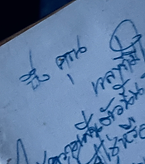
I miss(ing) us
4 hours & 54 minutes long
"How much longing can a single pen hold?"
“ปากกาด้ามหนึ่ง จะแทนความคิดถึงได้ขนาดไหน?”
“How much can a single pen hold of longing?” This work begins with this question. The artist uses a single ordinary blue-ink pen to write a prose poem across paper and polyethylene terephthalate film. The writing begins at the upper-left corner of the paper and continues toward the lower-right corner for 4 hours and 54 minutes, without stopping and without regard to when the ink will run out.
The prose poem takes the form of a letter addressed to a period of “us,” referring to the artist and a close friend. It is written from the present self, in which that sense of “us” no longer exists in the same form, looking back through reflection and contemplation to the time they once shared. The text recalls their dreams, hopes, imagined futures, and the paths they once expected to follow before arriving at a present in which they no longer live alongside one another. Writing therefore becomes an act of remembering, longing, and reflecting on a time that has passed.
Writing the prose poem continuously in a single session requires both physical and mental exertion. The 4 hours and 54 minutes therefore become not simply the duration of the creative process, but part of the work itself. As the writing continues, the ink gradually runs out, but the act of writing does not end with it. The pen continues to move across the surface, leaving traces of pressure and scratching in place of letters that can no longer be produced. Writing therefore gradually shifts from the production of language to the production of physical traces.
The [ ] in the medium description refers to this condition, Traces in space produced through the continuation of writing after the ink has run out. What remains is therefore not only text that can be read, but also traces of movement, pressure, and accumulated time embedded in the surfaces of the paper and polyethylene terephthalate film. The traces on the surfaces consist of ink marks, scratches made by the pen after the ink has run out, and deeper marks made into the polyethylene terephthalate film. These traces can be perceived through the movement of light and shadow across the surfaces. As the conditions of light change, some traces become more visible while others recede. The existence of these traces is therefore not fixed, but changes according to space, time, and the conditions of light.
I miss(ing) us 4 hours & 54 minutes long brings the past into relation with the time in which the work is being made through a process of writing that gradually shifts from language to trace, from memory to material, and from what is written to what remains visible on the surface. Although the time of “us” has passed, its traces remain and appear differently under changing conditions of space, time, and light.
“ปากกาด้ามหนึ่ง จะแทนความคิดถึงได้ขนาดไหน?” ผลงานชิ้นนี้ถูกสร้างขึ้นจากคำถามดังกล่าว ศิลปินใช้ปากกาหมึกน้ำเงินธรรมดาหนึ่งด้าม เขียนบทกวีกึ่งความเรียงลงบนกระดาษและแผ่นโพลิเอทิลีนเทเรฟทาเลต โดยการเขียนเริ่มต้นที่มุมบนซ้ายสุดของหัวกระดาษยาวลงมาจรดมุมขวาล่าง และดำเนินต่อเนื่องเป็นเวลา 4 ชั่วโมง 54 นาที โดยไม่หยุดการเขียนและไม่สนใจว่าหมึกของปากกาจะหมดลงเมื่อใด
บทกวีกึ่งความเรียงมีลักษณะคล้ายจดหมายที่เขียนถึงช่วงเวลาของ “เรา” ซึ่งหมายถึงศิลปินและเพื่อนรักคนหนึ่ง เป็นข้อความจากตัวตนในปัจจุบันที่ไม่มีความเป็น “เรา” เช่นเดิมอีกต่อไป กำลังรำพึงรำพัน ทบทวน และใคร่ครวญกลับไปยังช่วงเวลาที่ทั้งสองเคยอยู่ร่วมกัน ทั้งความฝัน ความหวัง เส้นทางชีวิต และสิ่งที่เคยคาดหวังร่วมกัน การเขียนจึงเป็นทั้งการระลึกถึง การโหยหา และการทบทวนช่วงเวลาที่ผ่านไป
การเขียนบทกวีอย่างต่อเนื่องรวดเดียวอาศัยทั้งพลังทางร่างกายและพลังทางจิตใจของศิลปิน เวลา 4 ชั่วโมง 54 นาทีจึงไม่ได้เป็นเพียงระยะเวลาของการสร้างสรรค์ แต่กลายเป็นส่วนหนึ่งของผลงานโดยตรง ขณะที่การเขียนดำเนินไป หมึกของปากกาค่อยๆหมดลง แต่การเขียนไม่ได้สิ้นสุดลงตามไปด้วย ปากกายังคงเคลื่อนที่ต่อไปบนพื้นผิว ทิ้งร่องรอยจากแรงกดและการขูดขีดไว้แทนตัวอักษรที่ไม่สามารถเกิดขึ้นได้ การเขียนจึงค่อยๆเปลี่ยนสถานะจากการสร้างภาษาไปสู่การสร้างร่องรอยทางกายภาพ
[ ] ในส่วนเทคนิคผลงานหมายถึงสภาวะดังกล่าว เป็นร่องรอยที่เกิดขึ้นจากการเขียนภายหลังจากที่หมึกได้หมดลง สิ่งที่เหลืออยู่จึงไม่ได้มีเพียงข้อความที่สามารถอ่านได้ แต่ยังมีร่องรอยของการเคลื่อนไหว แรงกด และเวลาที่สะสมอยู่บนพื้นผิวของกระดาษและแผ่นโพลิเอทิลีนเทเรฟทาเลต ร่องรอยที่ปรากฏบนพื้นผิวมีทั้งร่องรอยจากหมึกปากกา ร่องรอยขูดขีดจากปากกาที่หมดหมึก และร่องลึกที่เกิดขึ้นบนแผ่นโพลิเอทิลีนเทเรฟทาเลต ร่องรอยเหล่านี้สามารถรับรู้ได้ผ่านการเคลื่อนตัวของแสงและเงาที่ตกกระทบพื้นผิว เมื่อเงื่อนไขของแสงเปลี่ยนไป ร่องรอยบางส่วนปรากฏชัดขึ้น ในขณะที่บางส่วนเลือนหายไป การดำรงอยู่ของร่องรอยจึงไม่ได้คงที่ หากเปลี่ยนแปลงไปตามพื้นที่ เวลา และสภาวะของแสง
I miss(ing) us 4 hours & 54 minutes long จึงเป็นการร้อยเรียงช่วงเวลาที่ผ่านมาเข้ากับช่วงเวลาที่กำลังดำเนินอยู่ ผ่านการเขียนที่ค่อยๆเปลี่ยนจากภาษาไปสู่ร่องรอย จากความทรงจำไปสู่วัสดุ และจากสิ่งที่ถูกเขียนไปสู่สิ่งที่ยังคงปรากฏอยู่บนพื้นผิว แม้ช่วงเวลาของ “เรา” จะผ่านไปแล้ว แต่ร่องรอยของมันยังคงดำรงอยู่ และปรากฏขึ้นแตกต่างกันภายใต้เงื่อนไขของพื้นที่ เวลา และแสงที่เปลี่ยนแปลงไป

I miss(ing) us 4 hours & 54 minutes long
Performance, Prose Poetry, Ink, and [ ] on Paper and Polyethylene Terephthalate Film
Duration: 04:54 hours